In Wheel of Fortune, the third wheel round is the Prize Puzzle, in which the winning player not only wins whatever they earn from the wheel, but also an extra prize, typically a trip to a destination thematically tied to that round’s puzzle, e.g. Ireland for “KISS ME I’M IRISH” or Japan for “THE BEST SUSHI ON EARTH”.
These prizes typically range from $8,000 – $12,000, but can go higher if a premium brand (e.g. National Geographic Expeditions) is sponsoring the prize. In fact, here’s the distribution of prize values for the last year and change:
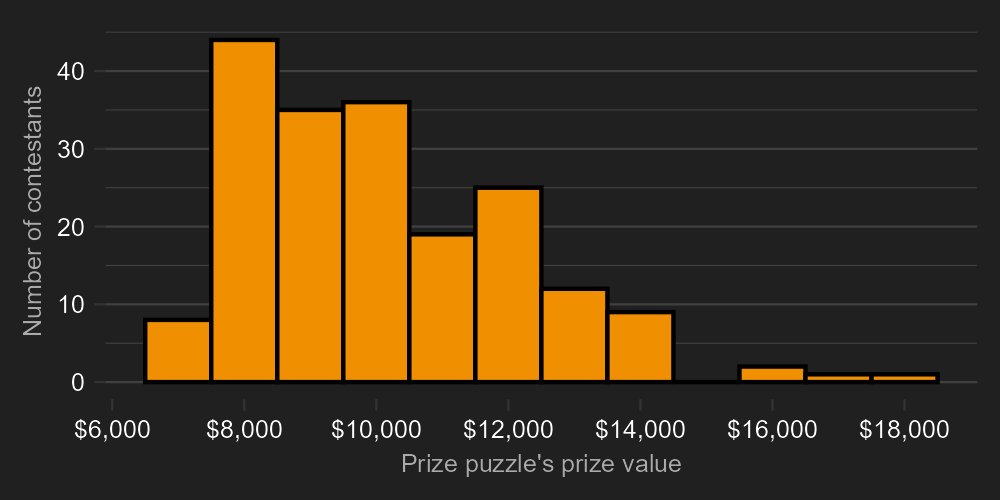
In other rounds, contestants may be tempted to continue spinning the wheel to earn more money even after they figure out the puzzle. But because the prize values are so high, and because prize values are used in calculating contestant totals and determining who goes to the Bonus Round, it makes strategic sense for contestants to solve the Prize Puzzle as soon as they can, even if they have no other winnings in the bank.
We Wheel fans see something all the time: a contestant has a largely unremarkable game, but they solve the Prize Puzzle, and the windfall from that round propels them to victory. At least, we think we see that all the time. But just how often does it happen?
Let’s start with the basics. With three players, each player begins the show with a ~33% chance of being the big winner. A player’s chance of winning then goes up and down throughout the Toss Ups and wheel rounds. Solving any puzzle, whether a wheel round or a Toss Up, will increase someone’s chance of winning the whole game. If we knew nothing about a player’s performance other than “This player won Round X,” what would that tell us about that player’s chance of winning the whole game?
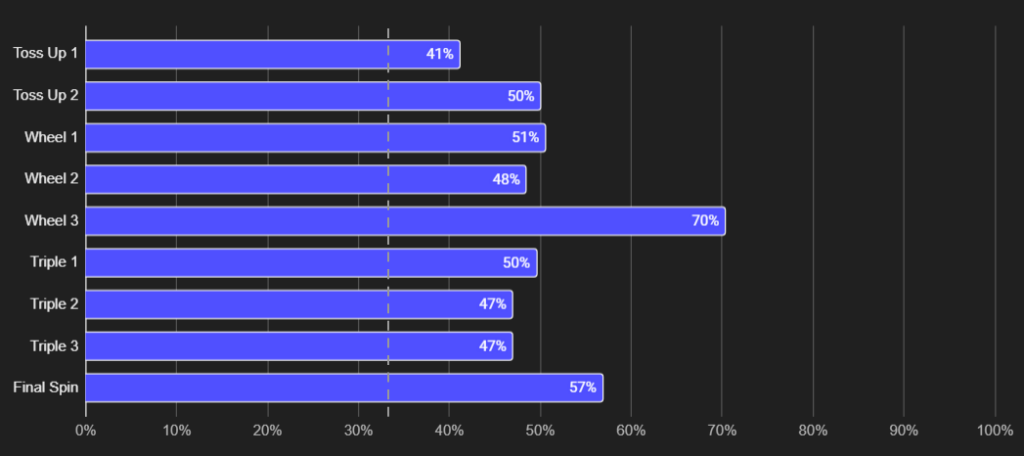
When I first looked at these numbers, two things surprised me. First, winning any single round, even the first Toss Up with its low dollar amount, bumps up someone’s win probability more than I expected. Second, while the Prize Puzzle round is easily the best predictor of full triumph, “only” ~70% of Prize Puzzle winners make it to the Bonus Round. I would have guessed closer to 90%, and I wonder if you might have been with me on that.
This means that, on average, you’ll see 1-2 episodes per week where the Prize-Puzzle-winning contestant doesn’t win the main game.
How often would the winner change if the prize value was excluded from totals?
I’m so glad you asked. First, let’s acknowledge that a rule change like that would certainly change player behavior. The Prize Puzzle features many more zero- and low-dollar solves than either of the first two rounds, since players want the prize and its value and are willing to forego spinning for more money in order to secure that value. That solve-as-soon-as-possible attitude would lessen with our proposed change, and the resulting high cash values could offset some of the effect of excluding prize values.
But screw all that. Let’s look anyway.

The number of Prize Puzzle winners who win the main game goes down a lot in this scenario: from 134 down to 84 as of this writing, or about 63% as often. To sum up:
- In 70% of episodes, the Prize Puzzle winner goes on to win the whole main game.
- In those episodes, excluding the Prize Puzzle’s prize value from player totals would deny the Prize Puzzle winner their main game win 37% of the time. (134 / 191 = 37%)
- That means across all episodes, excluding the Prize Puzzle’s value from player totals would change the winner 26% of the time (70% of 37% is 26%), or just more than once per week.
I am of two minds here. On the one hand, I expected the effects to be much larger because it certainly feels like we see these Prize-Puzzle-driven victories all the time. Perhaps this is a classic case of remembering certain types of occurrences as happening more often than they actually do. (I, as a sports fan, remember more horrible calls that hurt my team than those that help my team.) And, of course, contestants who hit special wedges in other rounds (e.g. the $10,000 “mystery” wedge or other prize wedges in the first two wheel rounds) benefit from the outsize value of those wedges just as the Prize Puzzle winner benefits from the guaranteed prize value.
But on the other hand, somebody is guaranteed to win the Prize Puzzle’s prize without needing a lucky spin to do so, and the inclusion of the prize value changes* the winner of the main game more than once a week, on average. So even if we are exaggerating its frequency, we are not simply imagining or fabricating its effect on game outcomes.
If anything, this confirms that players are employing an optimal strategy by solving the Prize Puzzle as soon as possible, securing a high dollar amount even while leaving extra potential winnings on the table.